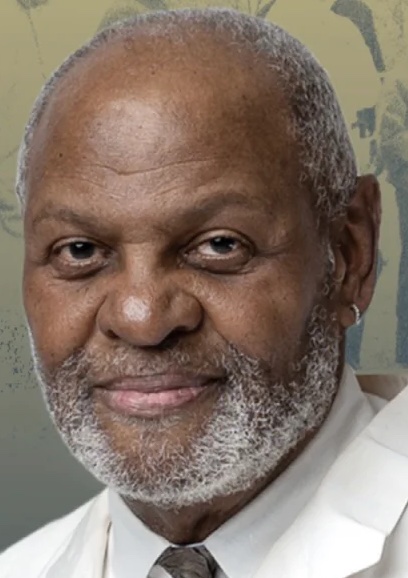
Dr. Bill Hurd ’69
2025 Inspiration award
As an All-American track star at Notre Dame, Bill Hurd set records that lasted for decades. But his real sprint—the fight for equality, education, and service—was just beginning. He went on to a career as a renowned ophthalmologist and philanthropist, restoring sight to thousands through global cataract surgery missions in underserved regions.
Dr. Hurd’s story is more than just a chronicle of achievements—it’s an inspiring testament to overcoming obstacles, breaking barriers, and using one’s gifts to uplift others. He tells his story in his recently published autobiography, Memphis to Madagascar: My Life in Focus.
Bill Hurd grew up in segregated Memphis, becoming a track star at all-Black Manassas High School. By the time he was a senior, he had run the 100-yard dash in 9.3 seconds, then an unofficial national high school record.
In addition, he won consecutive citywide math contests, completed two advanced placement courses, been elected senior class president and become the battalion commander of the National Defense Cadet Corps. His story made the cover of JET magazine in 1965. For college, he was ready to attend MIT on a full academic scholarship.
But then Notre Dame’s Alex Wilson, for decades a major force in track and field, made a trip to Memphis to watch Hurd run in a meet. “I was very impressed that a head track coach would travel all the way from Notre Dame just to see me compete,” Hurd recalls. “Ultimately, the choice was easy.”
Life at nearly all-white Notre Dame was, Hurd says, “at first, somewhat of a culture shock. But I knew I had nothing to be ashamed of. I felt just as prepared to succeed at Notre Dame as anyone else—maybe more so.”
Among the Black upperclassmen who looked out for Hurd’s well-being was Alan Page, All-American defensive end and. With some effort, Hurd was able to arrange his schedule in electrical engineering to be able to compete on the track team and continue to pursue one of his lifelong passions—performing music.
On a spring evening in 1967, after a track workout at the Athletic and Convocation Center, Hurd was approached by Ara Parseghian, who introduced himself—“as if I didn’t already know who he was”—and asked Hurd if he’d like to be part of the Fighting Irish football team, then defending national champion. Hurd had never played high school football because his dad was concerned about his safety.
“Without hesitation, I said yes,” says Hurd, who took jersey number 14 and played wide receiver for one season, as a backup to All-American Jim Seymour. “I caught a few passes from Terry Hanratty and Coley O’Brien and thoroughly enjoyed being a small part of the mystical Notre Dame football history.”
By his senior year, Hurd’s list of accomplishments was substantial. He had been selected Notre Dame Athlete of the Year 1968; become the track team captain; held the American record in the indoor 300-yard dash; held several Notre Dame track records, two of which still stand today (100 meters in 10.1 seconds and 200 meters in 20.3 seconds); and won the outstanding saxophone soloist award at the 1967 Notre Dame Collegiate Jazz Festival.
He was also nominated by Rev. Theodore Hesburgh to be a Rhodes Scholar. But Hurd would remain stateside, going to grad school at his original dream school, MIT, and its Sloan School of Management. The business education prepared him for involvement in the incubation of several minority business ventures in Nashville, including the establishment of a minority-owned and operated medical center.
Eventually, he found his way to Nashville’s Meharry Medical College, where he became an ophthalmologist. In 1982, as a resident physician under the guidance of the renowned Dr. Jerre Freeman, Dr. Hurd began participating in medical missions to medically underserved countries. The first trip, to Ometepec in southern Mexico, was the beginning of a long series of mission projects in Mexico, Brazil, China, South Africa, Senegal, and Madagascar.
“For almost twenty years,” says Dr. Hurd, “my mission colleagues and I restored sight to thousands of patients, and shared and exchanged knowledge of surgical techniques and medical diagnostic and therapeutic procedures with foreign host physicians.” Dr. Hurd is also a medical innovator and inventor, holding multiple medical technology patents.
Then there is his music. He has performed with several notable musicians including his long-time friend Kirk Whalum, fellow Memphis product, saxophonist, songwriter and multiple Grammy winner. Dr. Hurd makes trips back to Notre Dame to assist Larry Dwyer with the Notre Dame Jazz Festival and plays in a local quartet with Larry and two others.
Said Whalum of Dr. Hurd: “The legacy of achievement, diligence across multiple disciplines, and excellence that Bill set was a bar we all esteemed as unattainable. But the wonderful thing for me has been getting to know the kind, spiritual, humble man behind all of that achievement.”
“If you are going to pick a Notre Dame all-around student-athlete or a renaissance man, Bill Hurd has to be at the top of your list,” says Hanratty. “My friend and teammate brought world-class speed and brilliance to everything he did.”
Donate
Support the work of the Knute Rockne Memorial Society with a tax-deductible donation today.
Subscribe
Join our email list to receive the latest news and posts from the Knute Rockne Memorial Society.