Family of Harry Stuhldreher
2024 Legacy Award
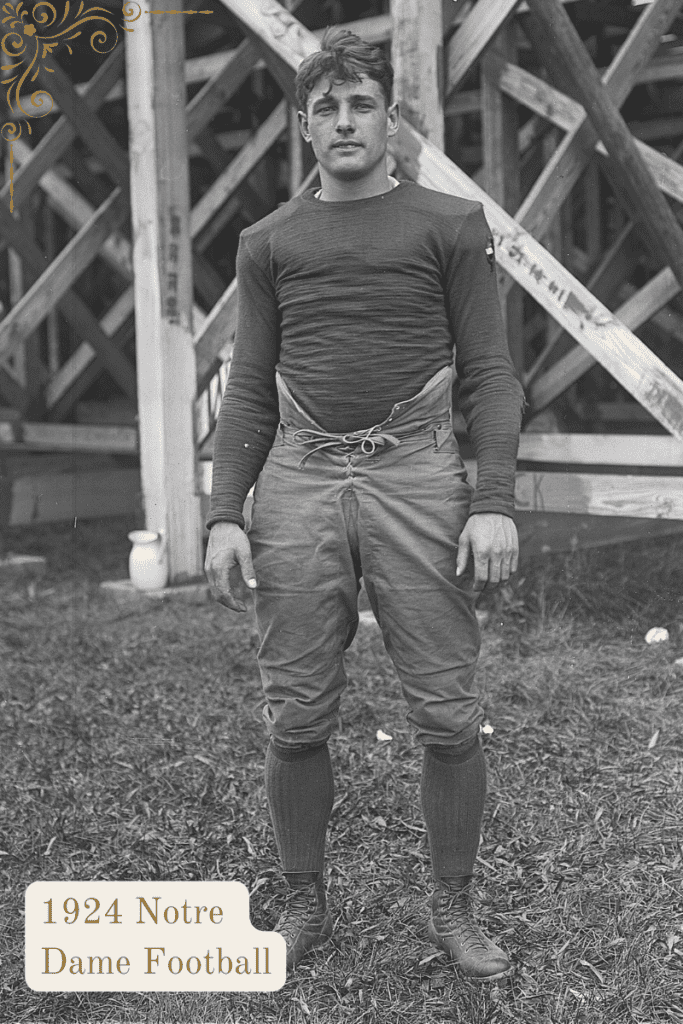
Young Harry Stuhldreher developed a great love for football while growing up near the center of Massillon, Ohio. He played for local sandlot teams, but he would be regularly teased for his slight stature—5-foot-7, 138 pounds. That only made Harry more focused on developing his speed, quickness and deception.
At Massillon Washington High School, “Hezzy” Stuhldreher was an undersized, scrappy ballplayer who took advantage of opportunity when it appeared. As a junior in 1918, he was a backup at the halfback and quarterback positions during a season shortened by the influenza epidemic.
In 1919, he saw more action when the regular starter went down with an injury. His size being a factor, it was decided that he could use a year of seasoning before facing the rigors of college, both athletically and academically. For the 1920-21 year, he enrolled at The Kiskiminetas Springs School about 50 miles east of Pittsburgh.
At Kiski, Stuhldreher led the squad to victories over the freshman teams from Carnegie Tech, Washington & Jefferson, and Penn, losing only to Pitt. The school annual hailed “our little bow-legged athlete. Here we have the rarest of combinations, namely, a whiz of an athlete and a scholar.” Stuhldreher’s older brother Walter had attended Notre Dame, not as an athlete but a scholar, and that’s where young Harry headed, to the delight of his family.
As a sophomore during the 1922 season, Stuhldreher gradually took over the starting quarterback spot from Frank Thomas (future Alabama coach of Bear Bryant) in the backfield that would become known as The Four Horsemen.
With the Notre Dame Shift, any of the four would be in position to receive the snap from center Adam Walsh, and the possibilities were endless. Each was a threat to throw or run on any given play. And amazingly for his slight stature, Stuhldreher was considered the best at laying “interference”—that is, blocking—among the four. He was also the primary punt returner. In three seasons, the sure-handed Stuhldreher returned 88 punts for 701 yards and a touchdown. And he caught 18 passes for 210 yards and a score. On defense, he intercepted three passes.
As a senior in the magical 1924 season, Stuhldreher led the team in passing, completing 25 of 33 attempts for a 758 percentage, 471 yards (a whopping 14.3 per attempt) and four touchdowns.
Harry’s final regular-season game for Notre Dame, against Carnegie Tech at Forbes Field in Pittsburgh, was notable in that it was the first college game his father William witnessed. William left his grocery store in Massillon in others’ hands for the day and joined a group of 100 Massillon supporters who took the train to Pittsburgh. Harry responded, leading a second-half rally that turned a halftime tie into a 40-19 Irish victory. He passed for two TDs and ran for a third.
In the Rose Bowl vs. Stanford, Stuhldreher played much of the game on a badly twisted ankle. With Stanford threatening in the fourth quarter, he made the key stop of Cardinal star Ernie Nevers in a goal-line stand that left the ball at Notre Dame’s six-inch line to seal the win.
Stuhldreher went on to a stellar career as head coach at Villanova and Wisconsin from 1925-48, before going into business as an executive with U.S. Steel. He died in Pittsburgh in 1965, having been inducted into the College Football Hall of Fame in 1958.
Donate
Support the work of the Knute Rockne Memorial Society with a tax-deductible donation today.
Subscribe
Join our email list to receive the latest news and posts from the Knute Rockne Memorial Society.